PD-1high alone or PD-1high CD39+? Comparing TIL therapy products with DETECT
TIL therapy works in melanoma, but in other solid tumours the infusion product often contains too few tumour-specific T cells. So when you change how you select the starting cells, how do you check that the final product actually got better? A study presented at SITC 2026 and published in the Journal for ImmunoTherapy of Cancer by Alejandro Ramírez-Chacón, Europa Gonzalez Navarro and colleagues used DETECT as part of that check.
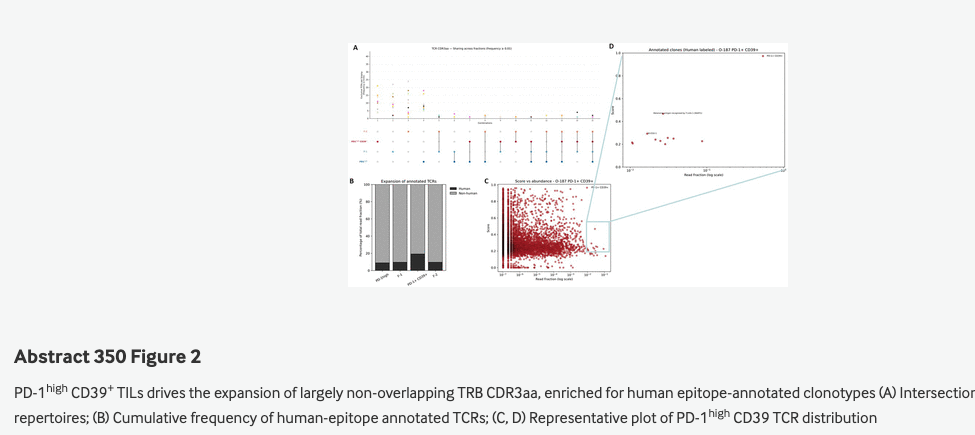
The team tested a dual selection strategy for lung adenocarcinoma: sorting tumour infiltrating lymphocytes that are both PD-1high and CD39+, with the aim of enriching for tumour-specific T cells and reducing bystander expansion. From 12 tumour samples they generated four TIL products each (PD-1high selected, PD-1high CD39+ selected, and the two negative fractions), expanded them, sequenced the TRB repertoire and annotated the sequences with DETECT.
Diversity metrics alone could not separate the two selection strategies: dual selection lowered TRB diversity compared to the negative fraction, but not compared to PD-1high selection. The specificity annotation did. The dual-selected product showed a higher cumulative frequency of clonotypes annotated to human epitopes than any of the other fractions.
That is what makes specificity annotation useful as a quality check in cell therapy development. Clone counts and diversity tell you how a product changed, DETECT adds what the expanded clones are predicted to recognise, so different manufacturing strategies can be compared on the property that matters.
These are conference abstract results, and the team is following up with single-cell experiments to characterise the PD-1high CD39+ population further.
Stay up to date
Subscribe to our newsletter to receive useful tips and information.