Cracking the Code of Cold Tumors: 4 Key Takeaways from CuraCell’s Approach to TIL Therapy
Tumor Infiltrating Lymphocyte (TIL) therapy is revolutionizing cancer treatment, but it has historically hit a wall when applied to "cold" solid tumors, cancers with low mutation burdens and scarce immune cell infiltration.
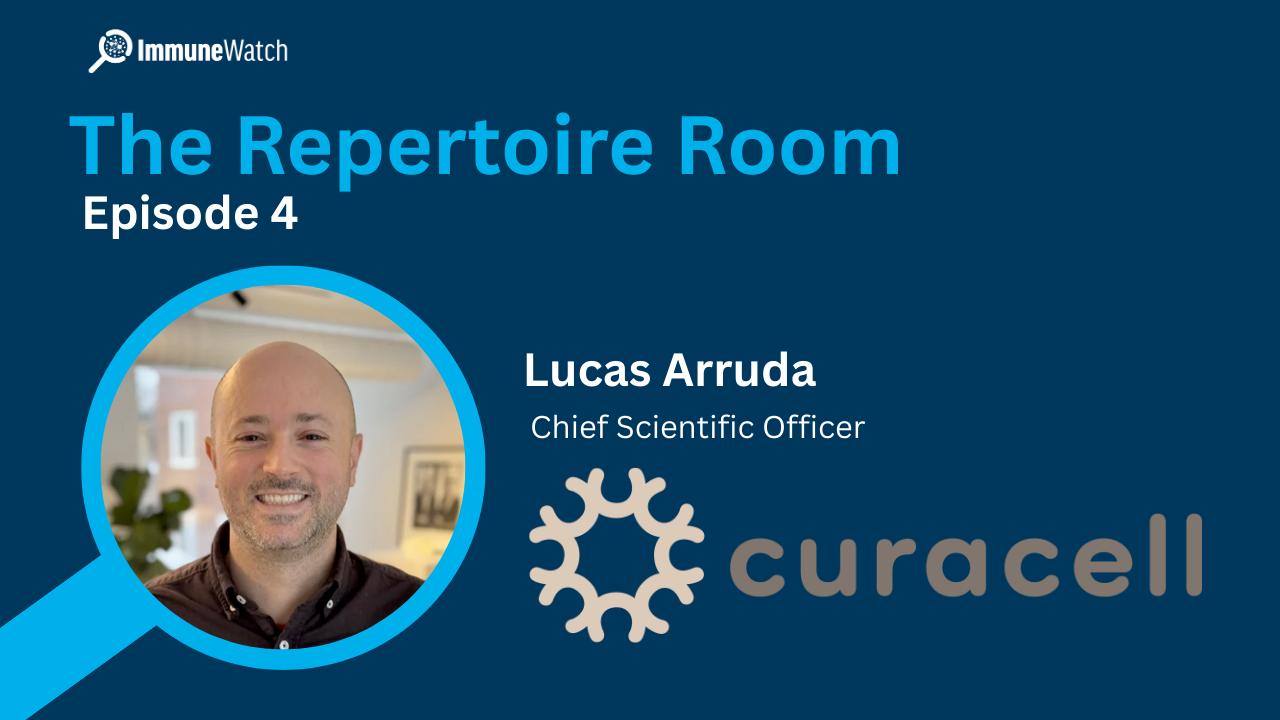
In the latest episode of The Repertoire Room, we spoke with Lucas Arruda, CSO of CuraCell, about how they are rewriting the rulebook for TIL therapy in indications like prostate and colorectal cancer. Their approach offers valuable lessons for any biotech working in the cell therapy space.
Here are four key lessons we learned from our conversation.
1. The "One-Shot" Myth Doesn't Apply to Cold Tumors
In "hot" tumors like melanoma, a single infusion of TILs is often sufficient to induce a durable response. However, Lucas explained that this "one-and-done" strategy falls short in cold tumors where the tumor microenvironment (TME) is incredibly harsh.
CuraCell found that a single dose often led to an initial expansion of cells followed by a rapid decline. By implementing a multiple dosing strategy, they observed a "sawtooth" pattern in pharmacokinetics: each new infusion re-invigorated the T-cell population, sustaining the pressure on the tumor and leading to better clinical responses.
2. Checkpoint Inhibitors Can Recruit "New Players"
One of the most exciting findings Lucas shared was the synergy between TILs and checkpoint blockade (like anti-PD-1).
When CuraCell combined their TIL therapy with checkpoint inhibitors in a patient, they didn't just see a boost in the infused cells. Using TCR sequencing, they discovered that the combination therapy actually recruited new T-cell clonotypes into the fight, players that weren't part of the original infusion. This suggests that the therapy can remodel the TME to make it more permissive to the patient's own immune system.
3. Manufacturing Consistency is a Regulatory Must
Moving from a single dose to multiple doses creates a new regulatory hurdle: Product Consistency. If you are infusing a patient three times, you must prove that the drug product in the third bag is biologically equivalent to the first.
This is where TCR sequencing transitions from a research tool to a critical quality control (QC) assay. CuraCell uses TCR sequencing to demonstrate to regulatory agencies that the clonal composition of their TIL product remains consistent across different manufacturing runs for the same patient. As Lucas noted, "The process is the product," and TCR data provides the fingerprint to prove that process is reliable.
4. Early Clinical Data Accelerates Optimization
CuraCell is now conducting a Phase 1/2a clinical trial in Germany for advanced solid tumors, including colorectal and prostate cancer. CuraCell’s journey was unique because they utilized "named patient" treatments (compassionate use) in Germany early in their development. This allowed them to gather real-world clinical data on manufacturing and efficacy before launching a formal Phase 1/2a trial.
By applying TCR sequencing to blood and tumor samples in these early patients, they could track bio-distribution and persistence in real-time. This feedback loop allowed them to optimize their expansion protocols and dosing schedules before entering the high-stakes environment of a formal clinical trial, significantly de-risking their program.
Want to hear the full story?
Listen to the full conversation with Lucas Arruda in Episode 4 of The Repertoire Room.
Stay up to date
Subscribe to our newsletter to receive useful tips and information.